

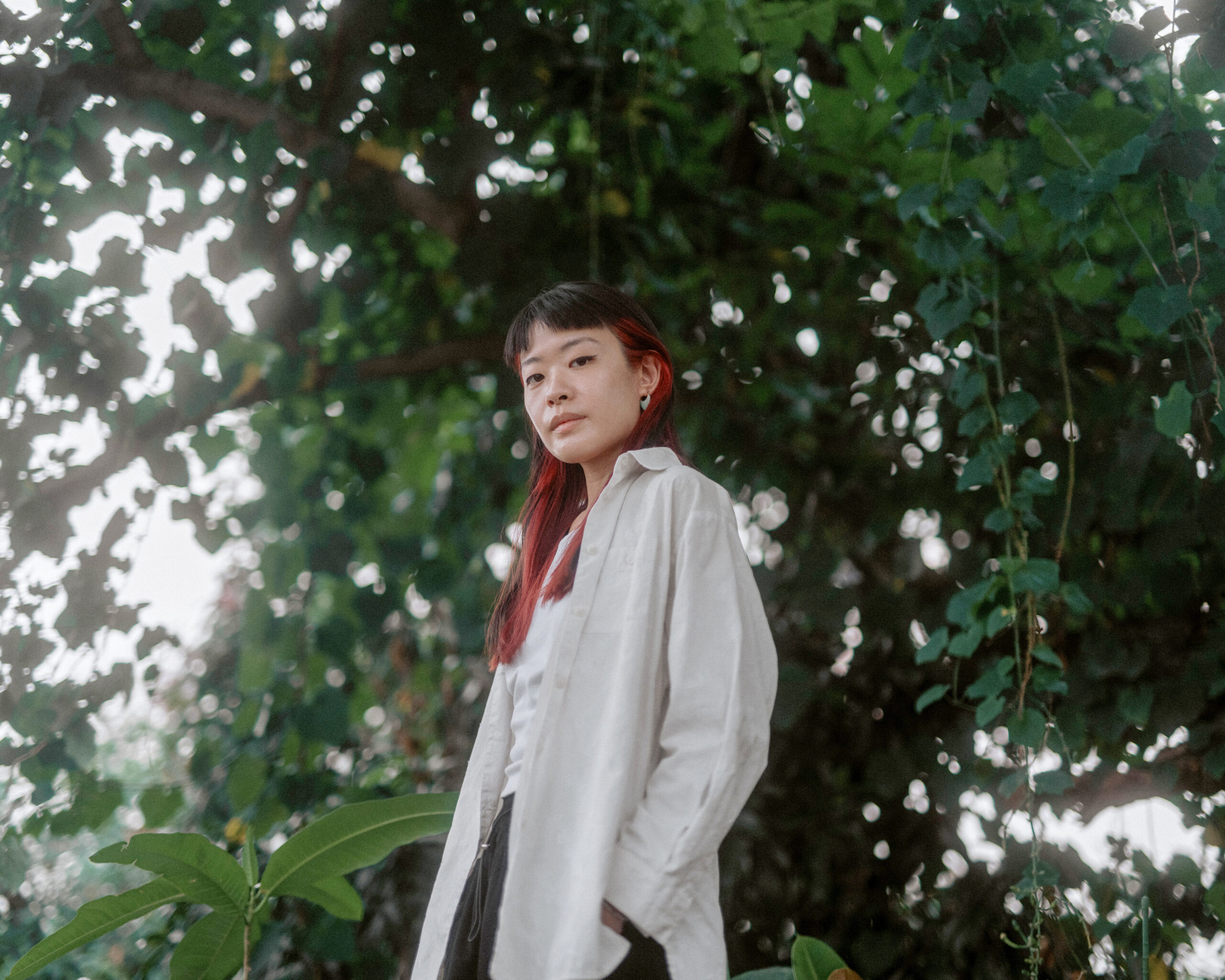
Born in Singapore and now mostly based in Berlin, contemporary artist Charmaine Poh works across film, performance and installation to explore technology, ecology, memory and repair. A former child TV star in Singapore, her work interrogates the circulation of images online and the construction of identity.
Her recent projects trace intimate lives at the social and ecological margins, from queer parenting to migrant domestic workers, integrating folklore and mythology into high-tech processes. Since completing Berlin’s GlogauAIR residency in 2019, Poh has gained rapidly gained international recognition and last year featured in Foreigners Everywhere at the Venice Biennale.
As well as co-winning the Villa Romana Art Prize 2026, you’re the Deutsche Bank “Artist of the Year” and you’ve just opened your first solo show in Berlin. Have you been surprised at the speed of your success?
It’s all pretty unexpected. Sometimes you try really hard with applications and you never get them and then other times these things just land in your life. It’s so strange.
You’re still doing all your own PR work by yourself? You don’t have a gallery?
Not yet! I’ve just been doing everything on my own, which is kind of nice but also exhausting. But you learn so much by doing it yourself. I really have to thank the curator of [the] 2024 Venice Biennale, Adriano Pedrosa, for everything. He just came across my work by chance while looking online. Then he contacted me over Instagram and after we sat down, he invited me to exhibit. I couldn’t believe my ears. That’s really what started it all. The Venice Biennale kicked off everything.
Your new exhibition, Make a travel deep of your inside, and don’t forget me to take, brings together sculptures, videos and installations in an intimate, immersive experience full of strange resonances and encounters. How did the concept come together?
I knew I wanted the space to feel a certain way: low light, curves, fabric, a meditative space. So I worked with a scenographer friend who usually works in theatre. We were able to talk openly about our approaches and bridge different aspects of my practice. I wanted the exhibition to take visitors on a journey, from the spectacle and consequences of technology to the stories that persist regardless of so-called ‘progress’. So the flow of the exhibition moves from high-tech to increasing materiality. At the end, you’re left with something very small and intimate.
You’re referring to your work, What’s softest in the world rushes and runs over what’s hardest in the world (2024), right? It’s a film that explores the difficulties faced by queer couples when raising children in Singapore without legal legitimacy. The way it is shot, overlaying spoken word accounts over close-ups of vegetation and creatures, suggests that how we treat the non-normative – human or ecological – is deeply connected.
Economically, Singapore is advanced, but socially, it’s very conservative. Queer families are still considered illegitimate
Yes. I tried to let the textures carry that connection: between human and non-human, between bodily life and ecological life. It’s informed by Daoist thinking too, and that’s where the title comes from.
For such a forward-thinking country, Singapore’s discrimination against non-heteronormative people is quite surprising. Why do you think this is?
I’m always thinking about how slowly the social shifts come. Economically, Singapore is advanced, but socially, it’s very conservative. Queer families are still considered illegitimate. Even with legal changes, public perception is slow to follow. There’s always this tension between ‘Asian values’ and so-called ‘Western liberal imports’. If you adopt neoliberal capitalist policies from the West, can you refuse its cultural ones?
Living between Singapore and Berlin must give you real insight into the differences.
Yes, and although I spend three-quarters of the year in Berlin, Singapore is still home. Singapore is a port, and there are so many different languages and experiences that arrive there and intermingle with each other and ultimately exist together in a very beautiful way.
In 2019 you participated in Kreuzberg’s popular GlogauAIR Art Residency. What was that experience like?
At that time, I was still mostly working in photography, but I’m really thankful for it because it allowed me to express myself without pressure. After that I went back to Singapore during the pandemic; everyone lost income, and it was a very stressful time. I felt like I was in survival mode. But it was during that time that I got access to my full digital archive from the [early 2000s] TV show [that I starred in], We Are R.E.M.. I was confronted by my past and decided to do something with it and the work GOOD MORNING YOUNG BODY came out of that.
That’s one of the main works in the exhibition, and it looks back to when you were a child acting star in Singapore. In the work, you use AI to create a deepfake of your younger self, revisiting how your prepubescent image was manipulated, used and taken from you. Do you still remember how you felt as a child?
It was the first time in years I had performed with my body again, embodying those old gestures, that voice
I think it all unfolded in a very careless way. I wasn’t ready for the attention. I’ve always been an introvert, and I don’t think anyone explained to me what it meant to be on television – the comments, the strange ways people would treat me. At that age, I thought of it as just something I did after school. I never thought about the long-term consequences. And this was also the early internet era. Phones weren’t online yet – it was all desktop computers – no filters, no moderation. So at age 12, I’d turn on the computer, go to these websites and suddenly see all these comments by strangers consuming and commenting on my image. It felt violating and shameful. But I don’t think I even recognised that at the time.
I can imagine your decision to revisit that footage wasn’t easy?
When I began rewatching the old footage, I did it not with shame, but with kindness. It was the first time in years I had performed with my body again, embodying those old gestures, that voice. I didn’t hide behind a character; I trained the AI model on my actual footage. But I think in a way, that risk is central to the work. And ironically, after releasing the work, I found it being discussed on the same kinds of forums that once mocked me. Reddit threads, comment sections – the same cycles resurfacing. But I’m grateful it found a platform. Not many contemporary artists have this kind of childhood experience to draw from.
Identity theft and deepfake pornography are increasingly serious issues, but in making the work, you had to engage with the very dynamics you’re critiquing.
The rise of deepfake porn is horrifying. It’s such a serious issue among teenagers making deepfakes of each other. Cases have skyrocketed because the technology is now so accessible, you can do it from your phone. I did a lot of research on this. My work is in dialogue with those developments. But it’s also personal. I ask myself, every time I make something in the YOUNG BODY series: ‘What is the risk for the audience? What are they being asked to confront?’ I don’t want the work to be a comforting AI chatbot. I want to create dissonance – make people feel slightly unsettled.
After the YOUNG BODY series, visitors enter your most recent film work, ‘The Moon Is Wet’: an immersive three-screen projection that weaves together the personal testimonies of Chinese migrants with folkloric history. The result is utterly transportive. In its dreamlike, whispered intimacy, the piece feels like a startlingly tender and vulnerable use of video technology.
I wanted to embody a sense of fragility and marginalisation. I wanted people to feel that liminality, maybe not consciously, but emotionally. So I shot entirely in the intertidal zone [at] low tide, when you can see the life that usually hides beneath the surface: sea cucumbers, hermit crabs, tiny shrimp. We filmed at 4am for several days to catch those moments. The intertidal zone is metaphorical for me: it’s in-between, transitional. Just like the women in the film – often invisible, but deeply present. These spaces are also the first to be destroyed by urban development, and that speaks to how expendable certain lives are seen.
The featured women are migrant workers from Guangdong, China. Why the focus on them?
They are known as the ‘Majie’ and in the 1930s, with the ending of the silk industry, they left to work abroad as domestic workers – many in Singapore. They had to take a celibacy vow in a ritual called the ‘combing-up ceremony’, which then allowed them to live independently. At the time, a woman could either be married or celibate; there was no real space for a single woman. I met some of these women in Chinatown, Singapore, about 10 years ago and photographed them. Most have passed away now. The film is a way of honouring their untold desires by reimagining them as young people.
In an essay for the exhibition catalogue, curator Stephanie Rosenthal writes that your work reflects a profound shift in how we experience technology. They also note your ability to filter migrant narratives, social rejection, ecological concerns and the impact of progress through a highly sensitive use of technology. Do you see your work that way?
I think what we do as artists often feels ungraspable. I see my role as opening a portal: an opportunity for someone to shift something inward. If I can do that, I’m content. But I don’t have the answers. If I did, I probably wouldn’t be making art. For me, it’s about asking questions and exploring possibilities. That’s the role of art: to open up processes that stay with you and continue to evolve.
Would you say your work captures a sense of multiplicity, showing connections that might otherwise go unseen?
Perhaps. Everything I do is personal. Every work reflects how I experience the world. Whether it’s my story or someone else’s, I try to handle it with intimacy. Sometimes my work expresses me better than I can [express myself] in everyday life. If I could say everything I needed to outside of art, I wouldn’t make it. But my work is where I can say everything I want to say.
- Make a travel deep of your inside, and don’t forget me to take, through Feb 23 2026, Palais Populaire, Mitte, details
